
Composition.
Keep approved content, customer data and business rules centralized so regulatory or product changes are not copied across dozens of templates.
Banking, financial services and insurance
Customer communications, digital portals, enterprise integrations and application support for financial-services organizations with complex operating systems.

BFSI technology services
AdventSys works on the applications and communication platforms between core financial systems and customers: high-volume communications on OpenText Exstream, self-service portals, integration layers and enterprise applications that need continuous enhancement and support.
Banks, lenders and insurers already have systems of record, years of customer data and operating processes that cannot stop while a new channel or platform is introduced. We therefore integrate carefully, modernize in stages and keep production continuity visible in the engineering plan.

Customer Communications Management
Customer communications management (CCM) connects enterprise data with the statements, letters, policy documents, notices and transactional messages customers receive. A mature CCM environment has to do more than compose a PDF: it must apply business rules and personalization, support multiple channels, execute high-volume production cycles and make operations visible when something fails.
AdventSys works with OpenText Communications (formerly Exstream) for communication design, development, migration, batch configuration, integration and production support. The objective is a communication estate that can change without introducing separate logic for every channel or relying on undocumented manual steps.

Digital banking and insurance applications
Customer portals and digital workflows often need to move faster than the core systems behind them. A well-defined integration layer allows a new web or mobile experience to use data and transactions from lending, policy, payment or customer systems while keeping those platforms behind controlled interfaces.
This approach is useful when the business needs a better customer journey now but a full core replacement is neither necessary nor practical. It also creates a cleaner boundary for future modernization because customer-facing applications no longer need to depend directly on every detail of the legacy platform.

Platform engineering and support
Financial-services platforms keep changing after launch: products change, integrations move, communication rules evolve and production issues have to be resolved without losing context. AdventSys supports applications through enhancement delivery, integration changes, platform upgrades, batch and production support, and long-term maintenance.
Keeping product knowledge with a stable engineering team is particularly valuable for systems with many interfaces and accumulated business rules. It reduces the time spent rediscovering why a process behaves the way it does every time a change request arrives.
Legacy communications migration
The difficult part is rarely the target platform. Long-running estates accumulate hidden complexity that has to be found before anyone commits to a migration date.
Large template estates often contain copied variants rather than distinct communications, so consolidation should happen before conversion.
Business logic can be embedded inside templates and may be the only remaining record of decisions made years ago.
New output may need to reproduce regulated or customer-facing documents exactly, with comparison and reconciliation evidence retained.
Old schedules, dependencies and restart procedures often surface late because they work but are poorly documented.
Core-system modernization
Core banking and policy-administration systems are replaced rarely. Most of what customers experience as outdated sits in the layer between those systems and the customer.
Modernization therefore focuses on portals, mobile journeys, communications and service interfaces that use core data through controlled APIs. The boundary is designed so customer-facing applications can evolve now and the core can eventually change without forcing everything in front of it to be rebuilt.
Selected BFSI work
Examples of work across statement production, communication modernization, customer portals and loan-processing platforms.
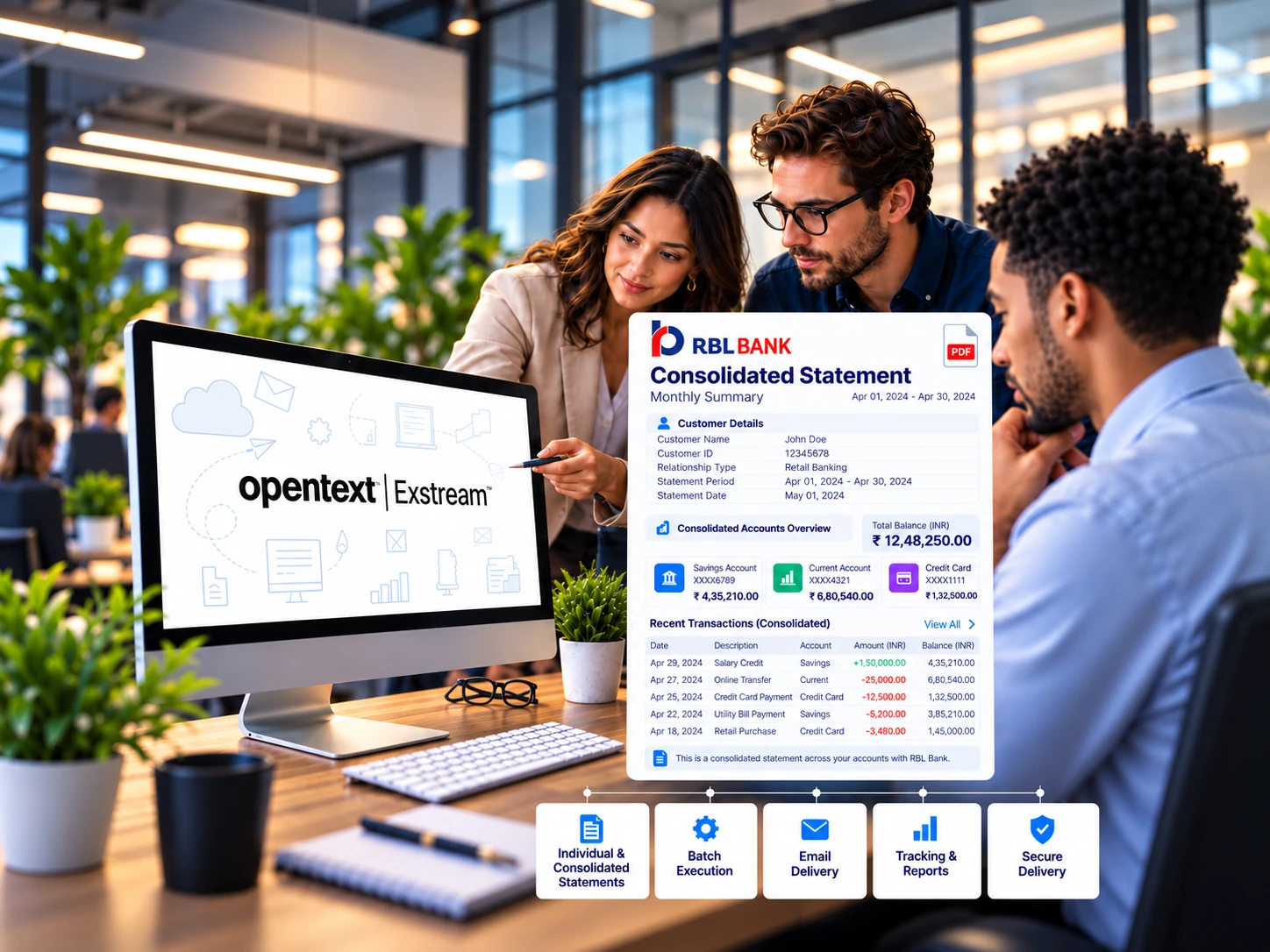
Statement production covering individual and consolidated customer communications, email delivery, batch execution and operational tracking.
View project
Migration of documents, letters and templates to a more flexible CCM platform supporting multi-channel customer communications.
View project
A customer-facing home-loan portal connected to core lending systems, giving borrowers direct access to information and servicing journeys.
View project
Replacement of legacy statement composition with OpenText Exstream and communication bundling for customer deliveries.
View project
A loan-processing platform supporting advisors and partner companies through structured digital workflows.
View projectFAQ
CCM platforms turn data from core systems into customer-facing communications such as statements, policy documents, letters, notices and transactional messages. The platform manages composition, personalization, channel-specific output and delivery workflows so high-volume communications can be produced consistently across print and digital channels.
Start by baselining the existing statement estate, data feeds, batch windows, output channels and reconciliation steps. Modernize in controlled groups, compare old and new output, prove peak-volume execution, and keep cutover and rollback plans aligned to statement cycles. Treat it as an operating-process change, not just a template conversion.
Yes. A customer-facing portal can be separated from core systems through APIs or a service layer, allowing the experience and workflow to improve without exposing or immediately replacing the systems of record. The integration design should define data ownership, security boundaries, failure handling and transaction consistency from the start.
Inventory the communication types, shared content, business rules, data sources, volumes, batch schedules, archive dependencies, delivery channels and operational controls. The hidden complexity usually sits in years of accumulated exceptions and integrations, so a reliable migration plan starts with what the current estate actually does.
Yes. OpenText Communications (formerly Exstream) is designed for customer communications across multiple channels. Shared data, content and rules can support print and digital outputs while channel-specific layouts and delivery requirements are handled separately. That reduces duplicated communication logic while preserving channel control.
AdventSys brings together customer communications, OpenText Exstream, portals, enterprise application engineering and integration for banking and insurance environments. This is useful when a customer journey spans several systems and the communication layer has to stay synchronized with product, customer and transaction data.
AdventSys has delivery experience around high-volume customer communications, digital portals and long-running enterprise platforms in BFSI. We focus on how new software will connect to the existing landscape and how critical customer-facing processes will be supported after release.
Yes, and it is the more common engagement. Much of our work is implementation, enhancement, upgrade and support on platforms clients already run, particularly OpenText Exstream. Replacement is a decision driven by the estate and the licence position, not something we recommend by default.
They are treated as controlled content: the approved wording is held centrally, changes go through review before release, the version that was sent to each customer is retrievable, and output comparison forms part of every release. In regulated communications the sign-off usually rests on the reconciliation evidence rather than on visual inspection.