
Recover business rules
We trace rules buried in scripts, forms and composition logic, and have business owners confirm them before anything is rebuilt.
AI engineering, integration and validation
We engineer AI into enterprise applications, customer communication estates and regulated processes — integrated with your systems, kept under human review, and validated where it has to be. The work is the integration, workflow and compliance around the model.
AI engineering
Four services, each starting from an operating problem and adding AI where it creates leverage.
Recover business rules, rationalise templates, assist drafting inside locked layouts and prepare accessibility remediation across large communication estates.
Explore this work ↗Extract, classify and route work with confidence thresholds, human review, audit logging and integration into the systems of record.
Explore this work ↗Run open-weight models, retrieval and agent workflows inside your infrastructure, private cloud or specified region when data cannot leave the boundary.
Explore this work ↗Read legacy code, stored procedures and business logic to build the documentation, rule inventory and regression coverage needed before modernisation.
Explore this work ↗Communication estates
We put AI on the slow, manual parts of running a large communication estate — recovering rules, rationalising templates, drafting inside locked layouts and preparing accessibility remediation, with human approval before anything ships.
We trace rules buried in scripts, forms and composition logic, and have business owners confirm them before anything is rebuilt.
We compare large estates to find near-duplicates, shared content and dead logic, turning an unscoped estate into a migration wave plan.
We generate inside approved layouts while regulatory text, branding and structure stay fixed, with human approval before release.
We produce alt text, reading order and structural tagging across existing PDFs for human conformance review.
Human review remains the control. AI prepares more of the work; a person still reviews the output before anything reaches a customer.
See the Customer Communication Management practice.Enterprise integration
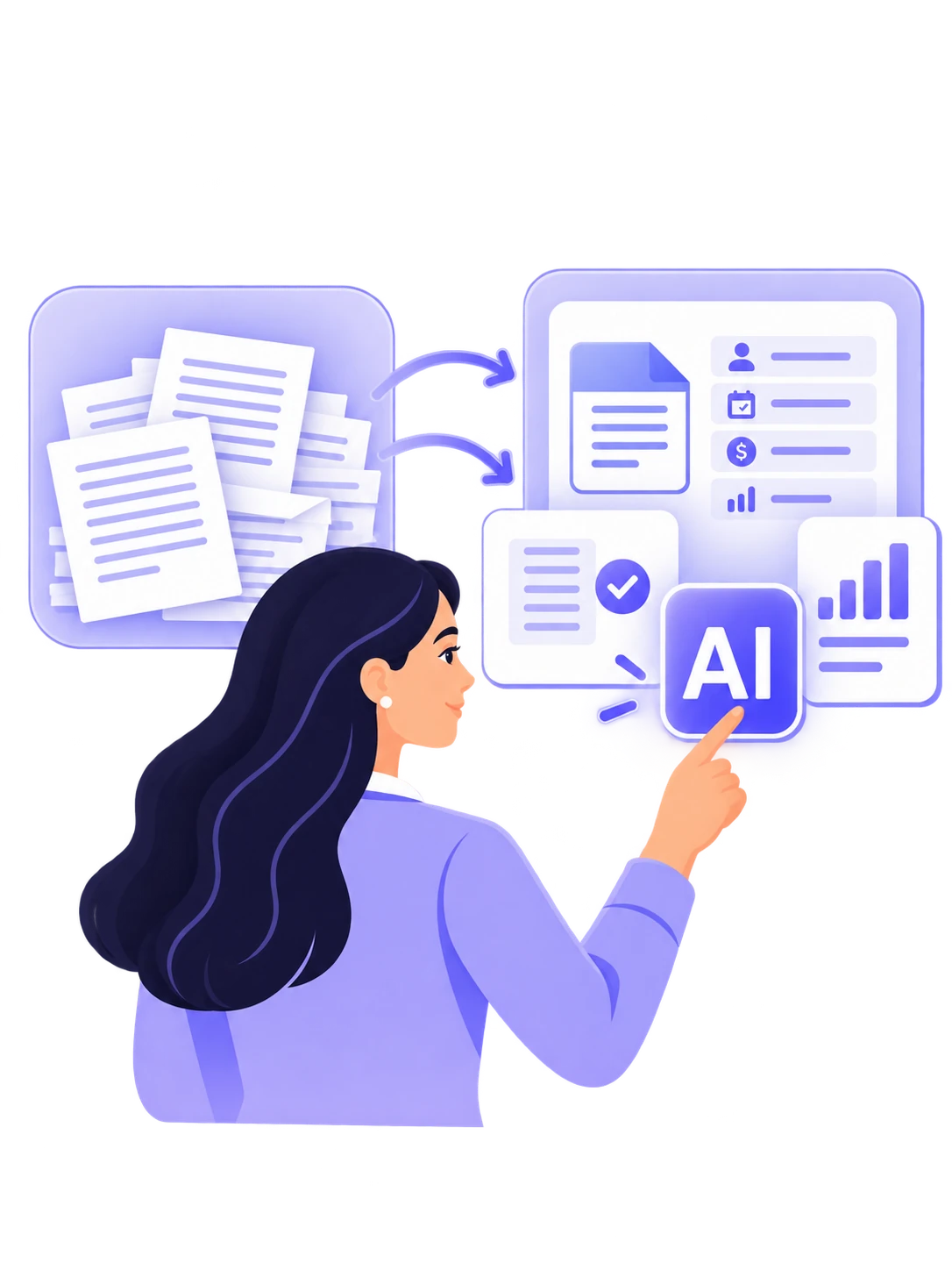
Extraction or classification is one step. We build the production path around it — routing, review, audit, integration into systems of record and defined failure behaviour.
Typical applications: onboarding verification, claim documents, invoice and PO extraction, correspondence routing and support-ticket triage.
We size against the real workload. If a person already handles the volume efficiently, automation may cost more than it returns.
Support operations
We classify and route incoming tickets, surface similar incidents and resolutions, and build a knowledge base from what engineers actually did. For existing managed-service clients, this upgrades the current support model.
Inside your boundary
When security policy, data residency or disconnected sites rule out external inference, we build AI that runs entirely inside your boundary — models, retrieval and agents, with data and logs staying in.
We answer from your documents with source citations, preserving the access permissions the content already carries.
We deploy inference inside your infrastructure, private cloud or specified region, with logs and data staying inside the boundary.
We connect agents to approval chains, systems of record, human sign-offs and defined failure handling.
We tell you where private models fit — extraction, classification, routing, structured summarisation — and where a hosted model would be materially stronger.
Legacy systems
When the specification no longer matches the system, we use AI-assisted code reading to recover how the application behaves, then have your owners confirm it before it becomes project input.
Application code, stored procedures, triggers, reports and conditional logic that accumulated after the original documentation stopped reflecting reality.
AI-assisted analysis + business-owner reviewEvery decision, where it is implemented and where rules conflict
What each module does in language the business can confirm
What reads from what and what breaks when an interface changes
Unused paths and the same rule implemented in several places
Tests derived from current behaviour so a rewrite can be proved equivalent
Scope based on what is in the code, not what the old specification claimed
Review before fact. Process owners confirm the recovered behaviour before it becomes project input.
Useful even without a rewrite. Rule inventories, dependencies and regression coverage make the current system easier to change safely.
Production AI
We take an AI use case to production through three gates: the decision, the system around it, and ownership after release.
Set the business decision, baseline, expected output and next action before choosing a model.
List cases the system must never decide alone and enforce that rule in the design.
Define sources, ownership, transformations, missing values, access and how production data reaches the model.
Watch input quality, outputs and exceptions; use review, thresholds and deterministic fallbacks.
Name owners for data changes, quality review, thresholds and retraining.
Check whether handling time, error rate or the target business decision actually improved.
FAQ
Typically two to four weeks. We look at the decision or process you want to improve, what it currently costs in time or error rate, where the data lives and what condition it is in, the regulatory classification, and the integration the result would need. You receive a written assessment: whether the use case is worth building, the approach that fits, what it would take, and the main risks. It is useful whether or not we do the build.
Reliable data pipelines, measurable quality, integration with the real workflow, security controls, monitoring, fallback behaviour and defined ownership after release. A model that only works on a prepared demo dataset is still an experiment.
As part of the application architecture, not a separate demo. Inputs, permissions, APIs, model outputs, human review, logging and exception handling each need defined interfaces so the capability operates safely inside the existing process.
Yes, treated as a computerised system in a regulated process from the start: intended use defined and approved, risk assessed against patient safety, product quality and data integrity, acceptance criteria agreed before build, traceability from requirement to evidence, change control over model and prompt revisions, and defined ownership and periodic review after release. We have run a computer system validation practice for nine years alongside the engineering team.
By building the review step into the system rather than relying on a policy. Output carries a confidence signal, defined case types are never decided automatically, generation happens inside approved templates where fixed content cannot be altered, and every decision and human action is logged. In customer communication, generated content sits inside a locked template with an approval step before release.
Because the hard part of an AI project is the integration, workflow and compliance around the model, and that is the work we do. We integrate AI into systems that already exist, build the workflow and review step around it, and validate it in regulated environments. The aim is to get something working inside your processes and keep it working.